Mental Health is Not One-Size-Fits-All: Why Cultural Humility Matters
June, 2026
Our mental health is shaped by much more than biology and psychology. It is also deeply influenced by our spiritual beliefs, cultural values, family systems, social identities, community support, and lived experiences. The way we understand distress, seek help, express emotions, and heal is often connected to the environments and traditions that have shaped us.
Yet, for many years, mental health care — and health care more broadly — has largely been shaped through Eurocentric frameworks. These frameworks have contributed greatly to the field, but they do not always fully capture the experiences, needs, and worldviews of individuals and communities from non-Eurocentric backgrounds.
As a result, people from diverse cultural backgrounds may face unique barriers when seeking support for everyday life challenges, emotional struggles, or mental health concerns. They may feel misunderstood, unseen, or judged. Their ways of coping, communicating, or making meaning may not always fit neatly into dominant clinical models.
This does not mean that mental health professionals are uncaring or unwilling to help. In fact, many are deeply committed to supporting people from all backgrounds. However, it is simply not realistic to expect any professional to know every culture, tradition, belief system, or lived experience in depth.
This is where cultural humility becomes essential.
Cultural humility is not about mastering every culture or becoming an “expert” in someone else’s identity. Rather, it is an ongoing practice of openness, curiosity, self-reflection, and respect. It asks professionals to recognize the limits of their own knowledge, examine their assumptions, and approach each person as the expert of their own lived experience.
Through cultural humility, mental health professionals can create space for more meaningful conversations. They can ask thoughtful questions, listen deeply, and work collaboratively with clients to understand what healing, support, and well-being mean within that person’s cultural and personal context.
This approach is especially important when working with communities whose mental health needs have often been overlooked, misunderstood, or stigmatized. For example, within many South Asian communities, conversations about mental health can be complicated by cultural expectations, family responsibilities, stigma, intergenerational differences, immigration experiences, and the pressure to appear “strong” or successful.
These experiences are not the same for every South Asian person, of course. No community is a monolith. But acknowledging these cultural layers can help us better understand why some individuals may hesitate to seek support, why symptoms may be expressed differently, or why family and community dynamics may play such a central role in healing.
Cultural humility allows us to move beyond assumptions. It helps professionals provide care that is not only clinically informed, but also human-centered, respectful, and responsive to the realities of people’s lives.
I recently had the opportunity to discuss these ideas on the podcast “Uplifting Minds,” hosted by the brilliant young Arnav Sehgal. In our conversation, we explored the importance of cultural humility and reflected on some of the mental health struggles and strengths within South Asian communities.
My hope is that this conversation encourages more awareness, compassion, and openness — not only among mental health professionals, but also within families, communities, and anyone interested in supporting emotional well-being.
Mental health care becomes more effective when people feel seen, heard, and respected. Cultural humility is one important step toward making that possible.
I invite you to listen to the episode of “Uplifting Minds” and join the conversation.
——————————————————————————————————————————–
My Superpower!
May, 2026
Recently, I had the privilege of attending a transformative workshop on Interprofessional Practice & Education (IPE) and Community of Practice Development. Picture this: health care professionals from all corners—including mental health!—coming together to celebrate their collaborative efforts to improve patient care. It’s inspiring to see everyone united by a common goal, making the circle of care complete. For me, this was especially meaningful—I’ve always been a passionate advocate for holistic patient care. You simply can’t treat a patient by looking at symptoms alone; every illness has biological, psychological, social, and even spiritual layers. It’s crucial that we, as healthcare professionals, keep this in mind!
Now, onto one of my favorite activities from the workshop: we were tasked with pairing up with someone from a different healthcare department. As fate would have it, I was partnered with Dr. Rajesh Mangrulkar, director of the Michigan Center for IPE itself! Talk about intimidating—his credentials are seriously impressive. Despite my initial nerves, by the end I was an enthusiastic Dr. Raj fan. He’s an incredible clinician and a genuinely insightful leader. Ann Arbor VA is lucky to have him as their director of internal medicine!
The real magic happened during our exercise: a “Generative Interview” where we practiced intuitive listening to discover each other’s superpower. Based on feedback from our partner, we were then encouraged to imagine and design our own action figure—how cool is that? I’ll admit, this was pretty daunting for me. I’m more experienced at self-critique than self-promotion! But thanks to Dr. Raj’s knack for articulating strengths, and the support of the University of Michigan Ann Arbor’s Center for Research on Learning & Teaching (CRLT), I was able to truly embrace my superpower.
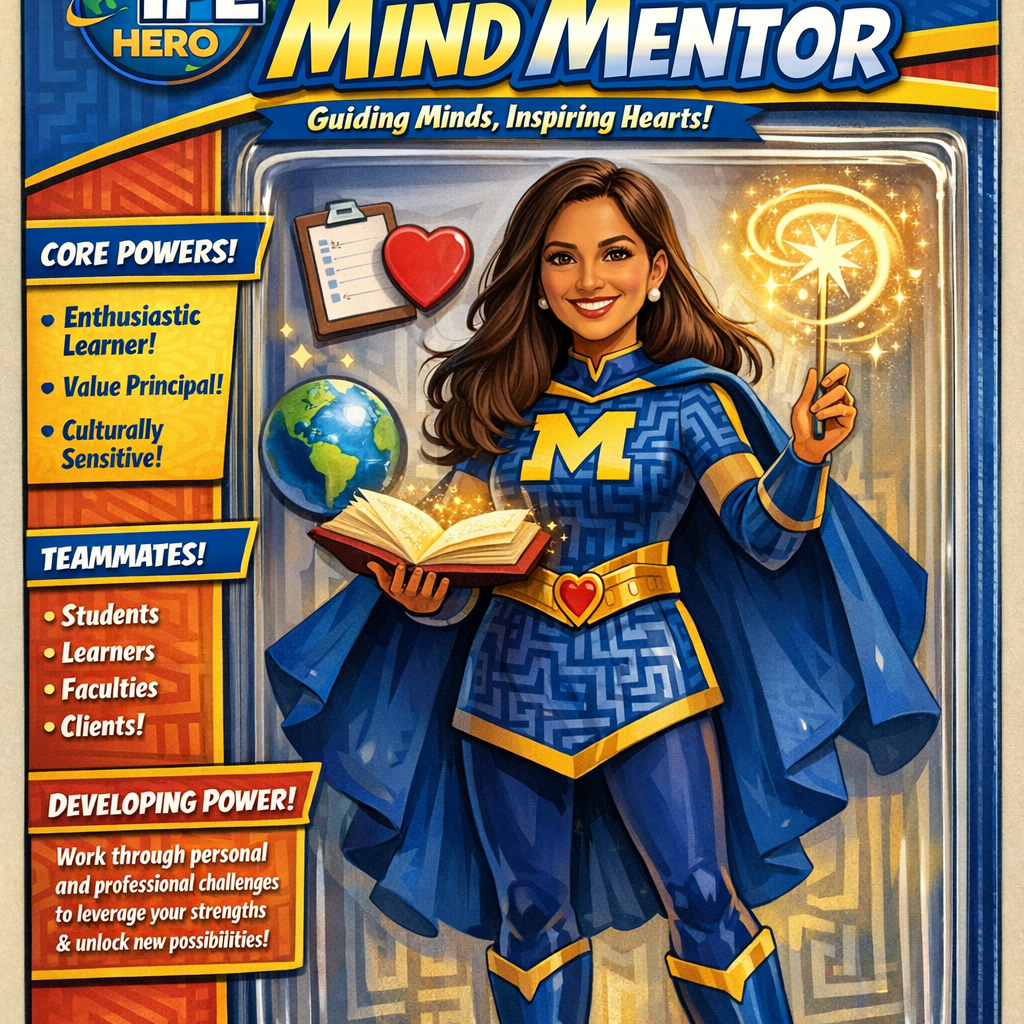
So, who did I become? I proudly introduced my action figure: the “Mind Mentor.” Dressed in bold maize and blue, this superhero embodies the spirit of enthusiastic learning, cultural sensitivity, and an unwavering commitment to holistic care. Armed with a wand of wisdom, a heart for empathy, and a book that fuels curiosity, my Mind Mentor guides minds and inspires hearts—not just in the classroom, but in every interaction with patients and colleagues. Creating this figure helped me recognize the strengths I bring to the healthcare team and reminded me that our superpowers shine brightest when we learn and grow together. Here’s to celebrating the hero in all of us!